The Many-Body Problem of Indian Life
Acronyms used in this post:
IT: Information Technology, the design and maintenance of computer systems, software, data, and networks.
ICU: Intensive Care Unit, the hospital unit where critically ill patients are treated.
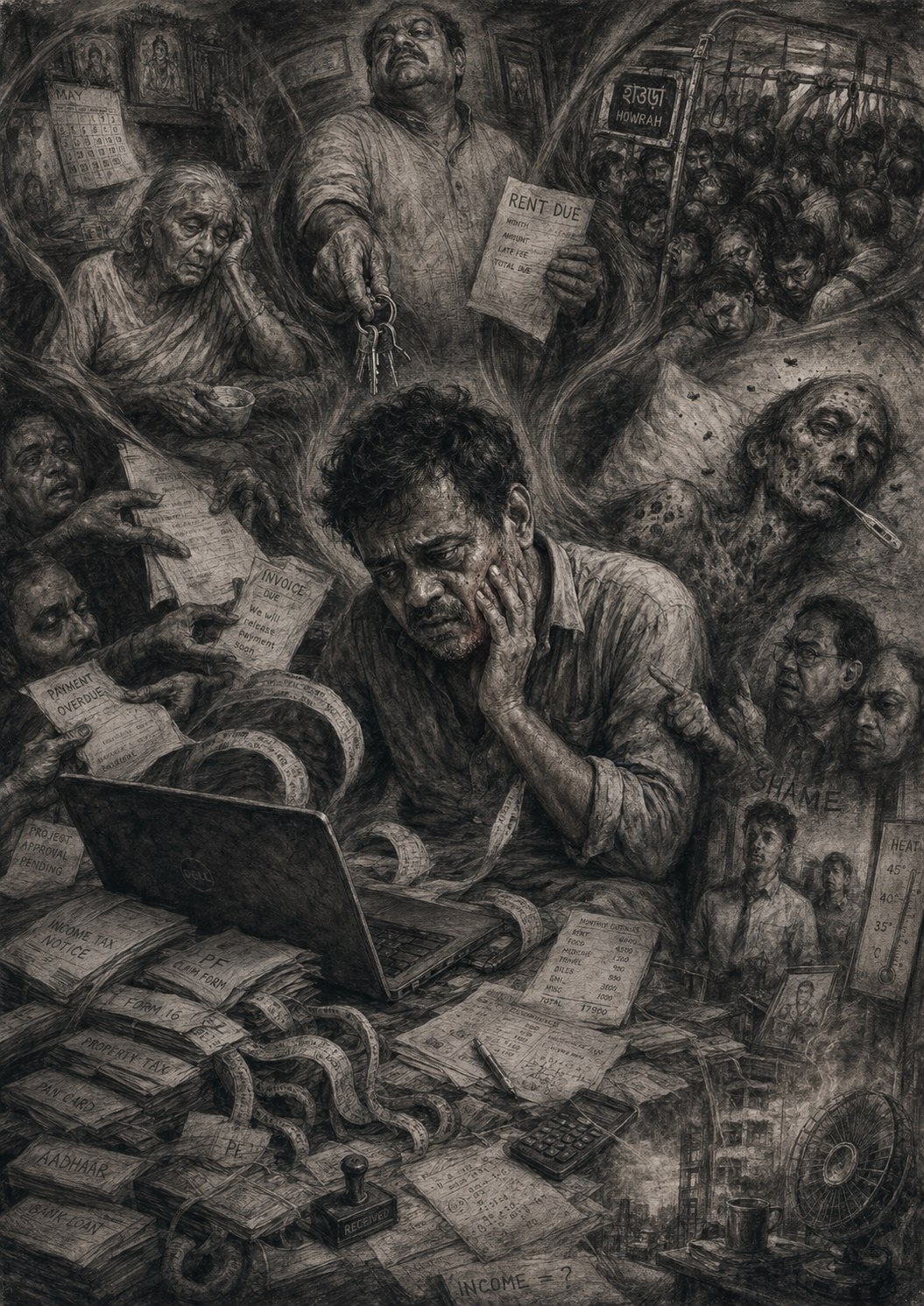
By nine in the morning the sweat under my left chest had become a small private Hooghly, and I was sitting in the shanty boondocks of Calcutta, scratching myself like a municipal monkey, trying to solve the first respectable problem of adult life.
Income.
Look at the word. So neat. So polished. It wears a belt. It probably files taxes on time and says “kindly” without sounding dead inside.
In reality income arrives, if it arrives at all, smelling of unpaid clients, broken sleep, rice cooker steam, toothache, electricity bills, and that faint sour fear which rises from the armpits when the bank balance begins to look less like a number and more like a medical report.
The fantasy is simple.
One man.
One laptop.
One invoice.
One problem.
A clean little adult equation.
But life, being life, has no respect for clean equations. Life is not a school exercise where two trains leave two stations and meet after three hours with full marks and no litigation. Life is a minibus on BT Road with a broken horn, a wet seat, a conductor with the lungs of a revolutionary, and fourteen people pressing into your ribs as if democracy were being kneaded into dough.
In physics, two bodies are already a respectable achievement. The Sun pulls the Earth. The Earth goes round the Sun. Newton looks at this and says, yes, this can be handled. A force here, a mass there, a neat curve, a little mathematics, and the heavens behave like a well-trained dog.
Then someone adds a third body.
The Moon turns up, wearing no invitation card, and suddenly the tidy drawing begins to wobble. The universe, which looked like a clock, begins to behave like an Indian family after someone mentions ancestral property.
One more object. One more pull. One more quarrel in the sky.
That is the many-body problem.
Scientists call it complex dynamics.
I call it gravitational bullying.
Because I wake up trying to solve income, and immediately the mother-body pulls.
Mother’s medicines. Mother’s transport. Mother’s age. Mother’s voice on the phone, thin now, like old paper kept too long in a damp drawer. She does not have to ask for anything. Her frailty has mass. Her silence has mass. Her memory of me as once bright, once promising, once perhaps heading toward something grander than this rented little room and its damp patch near the window, has the density of a collapsed star.
Then the landlord-body pulls.
Rent is gravity with a receipt.
Rent is the most honest philosopher in India. It does not care whether you were good in mathematics, whether you worked in America, whether you once knew how to build data systems, whether you have read books, whether your mind still glows in certain corners like a tramline after rain.
Rent says only one thing.
Pay.
Not explain. Not reflect. Not suffer beautifully. Pay.
If money attracts shelter, then insufficient money makes shelter look at you with the cold professional interest of a butcher examining a thin chicken.
Then comes the client-body, that famous Indian astronomical object: not quite a planet, not quite a comet, more like a gas giant made entirely of assurances.
Payment will happen soon.
Soon in India is not a unit of time. Soon is a fog. Soon is a devotional song. Soon is where invoices go to grow moss and philosophy.
The client says accounts department. Cash flow. Small delay. Next week. Brother, understand. We are all struggling.
And because you are educated, desperate, and still foolish enough to believe civilization is a thing, you understand everything except how to buy fish without checking your bank account as if it were a patient in the ICU.
Then the tooth pulls.
A tooth is not merely a tooth when money is tight. It becomes Parliament. It becomes the Election Commission of pain. It becomes a tiny rotten drummer inside the jaw, beating out its manifesto.
Throb.
You try to think of income.
Throb.
You try to write a proposal.
Throb.
You try to remember that you are a thinking man, a man of ideas, a man who once crossed oceans and worked inside institutions with air-conditioning and chairs that did not wobble.
Throb.
The tooth says: philosophy is nice, old fellow, but your grand ideas are mounted on meat.
This is an important correction. Pain is a rude but efficient tutor.
Then heat pulls.
Calcutta heat is not weather. Weather visits. Heat occupies.
It enters the room like a local tough with political backing. It sits on the neck. It presses the brain into chutney. The ceiling fan rotates with the moral commitment of a bored clerk stamping pension files in hell. It does not move air. It moves rumor.
You sit there in a lungi or old shorts, depending on how much dignity remains that morning, and the body becomes a leaking public works project. Sweat behind the knee. Sweat under the belly. Sweat along the spine. Sweat in places that should have remained private even from God, if God existed, which I do not think he does, though heat occasionally makes a strong argument for minor devils.
Try writing a serious email when your underwear is sticking to your soul.
Try doing strategy while your back is being steamed like momo.
Try being noble in June.
By this point you may say, all right, this is discomfort. Everyone has discomfort.
Yes.
But wait.
Because memory has not entered yet.
Memory is the oldest bully in the lane. It comes slowly, carrying trunks.
Here is America.
Here is the office badge.
Here is the highway.
Here is the salary.
Here is the cubicle.
Here is the clean restroom.
Here is the strange period of life when your sentences could produce money, when your brain, defective in its own private electrical department but still usable, could be rented to institutions that paid on schedule.
Here is the younger body. Not handsome. Let us not become ridiculous. But less folded. Less apologetic. Less like furniture rescued from a flood.
Memory is gravity from the past.
Einstein said gravity was not simply a force but a bending of space and time. He was not thinking of a rented room in Calcutta, but he might as well have been. Debt bends the week. Shame bends the morning. Old failure bends the future until every plan rolls quietly back toward the same drain.
This is why motivational people should be wrapped in soft cloth and placed on a slow boat to nowhere.
They speak as if life is billiards.
Hit ball. Strike target. Produce result.
Lovely.
But a lower-middle-class Indian life at fifty-one, with unstable income, bad sleep, aging family, health trouble, and a mind that sometimes behaves like a ceiling fan with one loose blade, is not billiards.
It is not even chess, though every man with a microphone now thinks he is playing four-dimensional chess because he read one book about habits and began waking at five like a colonial rooster.
No.
It is an N-body simulation running on an old laptop with twenty-three browser tabs open, low battery, and a power cut expected before lunch.
Bureaucracy pulls too.
One document asks for another document to prove that the first document had the moral right to exist. The second document must be signed by a man behind a glass panel who looks as if joy once came to his counter and was rejected for improper formatting.
A portal fails.
A payment gateway spins.
A helpline says your call is important.
This, in modern civilization, means your call has already been cremated.
Age pulls.
Age is not just a number. That is one of those cheerful lies printed on coffee mugs by people with gym memberships.
Age is the narrowing of exits.
At twenty-five, failure is dramatic. You can wear it like a wet coat and still look interesting. At fifty-one, failure becomes furniture. Bed. Chair. Damp wall. Medicine strip. Tooth pain. Phone at twelve percent. A towel that never fully dries. A bank app you open with the same expression villagers once reserved for telegrams.
The young can romanticize uncertainty because their knees still believe in tomorrow.
At this age even hope needs reading glasses.
Then shame pulls.
Shame is internal gravity.
Nobody has to insult you every morning. India has trained you to do the work yourself, properly and at no extra cost.
You wake and the call center opens inside the skull.
Thank you for contacting Shame Support. Your humiliation is important to us. All our agents are currently busy comparing you with men who bought flats, raised children, installed air conditioners, joined housing committees, and post airport photographs with neck pillows and expressions of mild global importance.
You try to close the call.
It remains open.
Meanwhile public transport pulls, even on days you do not travel.
The bus. The auto. The metro crowd. The bargaining. The diesel smell. The hair oil. The wet umbrella. The old seat. The elbow entering your ribs with the confidence of a constitutional amendment.
To step outside is to become one particle in a sweaty gas of ambition, irritation, deodorant failure, and ancestral disappointment.
Every commuter is a vector.
Every conductor is a disturbance.
Every pothole is physics delivered through the spine.
Henri Poincaré, a French mathematician with a fine moustache and the misfortune of being too intelligent, studied the three-body problem and found that tiny differences at the beginning can produce wildly different results later. This became one of the great doors into chaos theory.
A small change here. A huge mess there.
People like to explain it with butterflies and storms.
Very pretty.
In my case the butterfly is usually a bank notification.
One unpaid invoice becomes one delayed rent.
One delayed rent becomes one sleepless night.
One sleepless night becomes one sharp email.
One sharp email becomes one lost client.
One lost client becomes one month of rice, eggs, tea, and elaborate private humiliation.
So what is an Indian life of this kind?
Sensitivity to initial conditions, plus no safety net, plus relatives.
There is the catch.
There is no isolated system.
That is the lie sold by career gurus, management insects, spiritual entrepreneurs, and men who shout into microphones under LED lighting. They say improve yourself, as if the self were a sealed laboratory bottle.
But the self leaks.
The self has a mother, rent, heat, teeth, old classmates, bad digestion, unpaid invoices, political noise, electricity bills, software updates, neighbors, mosquitoes, and a body whose mitochondria appear to have unionized and are refusing overtime.
So I sit with the laptop open.
The cursor blinks.
It has the expression of a small official expecting a bribe.
The problem is income.
The actual system is everything.
My mother’s aging orbit intersects my bank account. The landlord’s orbit intersects my stomach. The client’s orbit intersects my sleep. The heat’s orbit intersects my temper. The tooth’s orbit intersects my manners. Bureaucracy intersects my blood pressure. Memory intersects my vanity.
Even desire, that old circus monkey, wakes occasionally, looks around the tent, sees the damp wall, the unpaid bill, the tired body, the rice cooker, the fan, the cracked plastic bucket, and says: really? Here? In this economy?
At fifty-one desire is less rocket launch and more damp matchbox negotiating with monsoon.
Sometimes I think the only honest diagram of my life would be a blackboard full of arrows, all pointing inward, toward one small sweating dot labeled me.
But not a noble mathematical dot.
A Bengali dot.
Hairy. Anxious. Under-bathed. Tea-soaked. Full of resentment, education, gastric acid, and one stubborn little ember of optimism that should have died years ago but, like a roadside tea stall, somehow opens again.
The physicists at least get equations.
I get phone calls.
I get reminders.
I get polite unread messages that sit on the phone like lizards on a wall.
Every object in the room has extra mass. The rice cooker is not only a rice cooker. It is food and solitude. The tea pan is habit and nausea. The laptop is work and accusation. The bed is rest and surrender. The mirror is a police lineup where I am always the suspect.
No wonder the orbit decays.
No wonder the mind, pulled by fifteen invisible bodies before breakfast, begins to wobble like an old fan blade.
Some lives are not tragedies. Tragedy has shape. Tragedy gets music. Tragedy gets lighting. Tragedy gets critics.
Some lives are badly maintained simulations, full of rounding errors, heat noise, service charges, missing passwords, unpaid work, and one programmer who left the company in 2016 and cannot be reached.
By noon the sweat has dried and returned twice. The tooth has held a rally. The client has not paid. The landlord continues to exist with the peaceful mass of Jupiter. The mother-body turns slowly somewhere in another room of worry. Outside, Calcutta continues its old business of boiling, bargaining, shouting, frying, promising, collapsing, and surviving.
I sit before the laptop and try again to solve one problem.
Income.
And the universe, that ancient landlord with no maintenance budget, keeps adding bodies.
Then, from somewhere inside me, my stomach makes a wet democratic sound.
Another motion of no confidence has passed.